3. Time-travel scrubbing
A user reports a bug. "I clicked three things and then the page went wrong." They can't reproduce it on demand. You can't either.
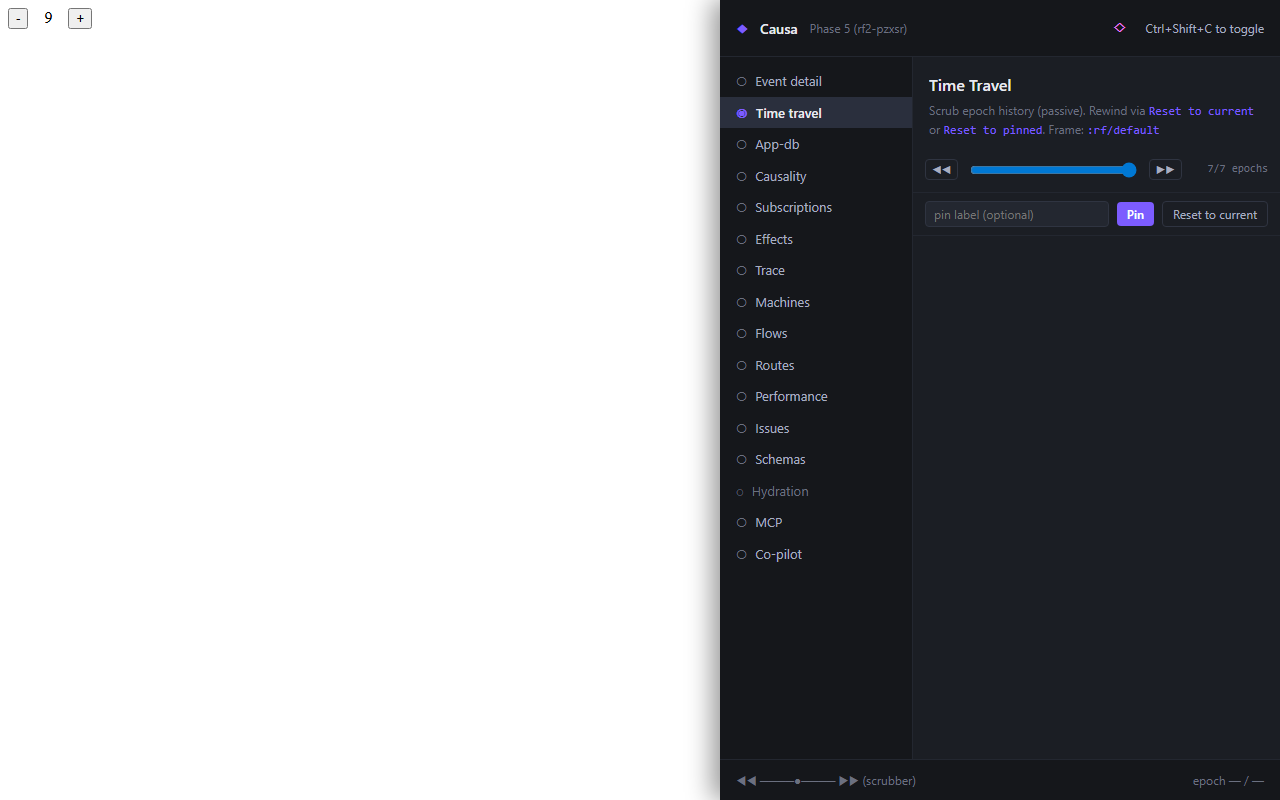
In a mutable-state app, this is the worst class of bug — you're chasing a sequence of writes you can't replay. In re-frame2, every drain-to-empty is recorded: the event that triggered it, the :db-before, the :db-after, the subs that recomputed, the renders, the fxs. That's an epoch. The runtime keeps a ring buffer of them — fifty per frame, configurable — and Causa renders the buffer as a scrubber.
You walk backwards. Find the cascade that broke the invariant. Rewind to before it ran. The bug isn't a story you reconstruct from logs; it's a :db-after you can pprint.
The rail
The scrubber sits at the bottom of every panel — it doesn't go away when you switch from Event detail to Trace to Subscriptions. That's deliberate: time-travel is cross-cutting. Whatever panel you're looking at, you can rewind the rest of the world out from under it.
Three controls:
- Drag the cursor backwards — passive scrub. The other panels retarget at the historical epoch, but the live
app-dbis unchanged. You're previewing. - Click restore — active rewind. The runtime calls
restore-epoch, the host frame'sapp-dbswaps to the historical:db-after, and the live views re-render against it. The runtime emits a:rf.epoch/restoredtrace event so other tools (your own listeners,re-frame2-pair, an in-house APM bridge) see it land. - Click jump-to-event — when you know the event you want to rewind past, you don't have to find the epoch by index; you type the event-id and the scrubber positions to the most recent matching cascade.
Passive scrub is the one you reach for most. It's read-only — you can run the entire investigation without ever mutating live state.
How the buffer fills
Every drain-to-empty produces one epoch record. The record carries:
:epoch-id,:frame,:committed-at,:event-id,:trigger-event:db-before,:db-after:sub-runs— every sub recomputation in this cascade (cache-hit subs are absent):renders— every view that re-rendered, keyed[<view-id> <instance-token>]:effects— every fx that fired, with:outcome∈{:ok :error :skipped-on-platform}:trace-events— the raw trace slice, optionally
This is what tools route diagnostics off — Causa's epoch-grouping, re-frame2-pair's "show me the last five cascades" command, the post-mortem path that captures a session for review. Same record, three consumers.
The default buffer depth is 50 epochs per frame. To deepen:
Two-million epoch slots and you've got a memory leak; fifty is a comfortable default for the "I just want to scrub backwards through the last few minutes" workflow.
Redacted records
If you've installed an :epoch-history :redact-fn to keep secrets out of recorded :db-before / :db-after ((rf/configure :epoch-history {:redact-fn (fn [record] …)})), Causa renders the redacted shape. The runtime invokes your fn once per epoch before the ring buffer is appended, so every panel — App-DB Diff, Event detail, the scrubber preview — sees the same redacted record. Slots your fn rewrote appear as the :rf/redacted sentinel (or whatever shape you substituted); there is no separate raw copy to recover from. One consequence for time-travel: a confirmed rewind to a record whose :db-after was redacted will land app-db in the redacted state — the rewind structurally succeeds but the resulting state is not what the user observed at record time. Apps that need restore fidelity should leave :db-before / :db-after alone in the fn and redact only :trace-events / :trigger-event.
The six failure modes of restore-epoch
Active rewind can fail. Six modes, each with a structured error trace event:
| Failure | When |
|---|---|
| Unknown frame | The frame-id doesn't name a registered frame. |
| Unknown epoch | The epoch-id isn't in the frame's current history (aged out, or never recorded). |
| Schema mismatch | The recorded :db-after doesn't validate against the currently-registered schemas (someone added a stricter schema since the snapshot). |
| Missing handler | The recorded app-db references a registered id (a machine, a route) that's no longer in the registrar. |
| Version mismatch | The frame's recorded :rf/snapshot-version is incompatible with the currently-loaded machine definition. |
| Concurrent-drain rejection | Called while the frame's drain is still in flight; retry after settle. |
restore-epoch returns true on success, false on any failure. Causa renders the failure mode inline at the scrubber — a red toast carrying the :reason (unknown / concurrent-drain), the :explain Malli output (schema mismatch), the :missing-id (missing handler), or the :expected/:got versions (version mismatch). You don't have to know what went wrong from a stack trace; the runtime told you.
Effects already fired
One caveat. restore-epoch rewinds the frame's app-db — state. It does not un-fire effects that already left the system. The HTTP request was sent. The navigation was pushed. The Sentry event landed. Rewinding to before those fxs ran rewinds the record of them; it doesn't un-send them.
Causa surfaces this with an Effects already fired chip when you rewind past an epoch that contained non-:skipped-on-platform fxs. The chip is advisory — it doesn't block the rewind, just makes the asymmetry visible.
In practice, most of the time the asymmetry doesn't bite: you rewind to investigate, you read the new state, you make a fix, you don't keep the rewound state around to ship from. But it matters when you're chasing "we got two confirmation emails for one order" — the rewind doesn't unsend the second email, and Causa is correct to remind you of that.
Reset to an arbitrary state
Sometimes the state you want never existed: a bug repro arrives as serialised app-db, an agent has hot-swapped a handler that needs an evolved shape, a story-tool wants to render a specific snapshot. reset-frame-db! is the bypass:
It replaces the frame's app-db directly, records a synthetic epoch (so restore-epoch can later rewind past the injection), and emits a :rf.epoch/db-replaced trace event. The synthetic epoch carries empty :sub-runs / :renders / :effects projections — those are the visible signal that no cascade ran.
Causa renders the synthetic epoch differently in the scrubber — a small star marker — so you can tell which entries came from real dispatches and which from direct injection.
reset-frame-db! is not a substitute for dispatch. Use it only when bypass-the-cascade is required.
When the scrubber isn't the right tool
Two cases where you'd reach for something else:
- You want to debug the cascade as it happens, not after. Time-travel rewinds; it doesn't pause. For pause-on-event behaviour, hot-swap the relevant handler with a
js/debuggerline viare-frame2-pairand replay the event. - You want to reproduce a bug a customer saw in production. Time-travel works on the current runtime's epoch history. Customer sessions are off-box; you'd need their epoch record exported, then imported into a local frame via
reset-frame-db!. That round-trip is the Story playground's job — it can mount anyapp-dbsnapshot as a variant.
Next: the trace stream — the raw bus underneath everything you've seen so far.