5. Click-to-source
The hero feature.
In practice, this is the surface you reach for when a tester drops a screenshot on your desk and says "the wrong number is showing here." You don't grep. You don't binary-search the view tree. You point Causa at the rendered element, read the coord off the DOM node, and you're inside the function that produced it.
Every element knows where it came from
Open any re-frame2 app in dev mode and inspect any rendered element:
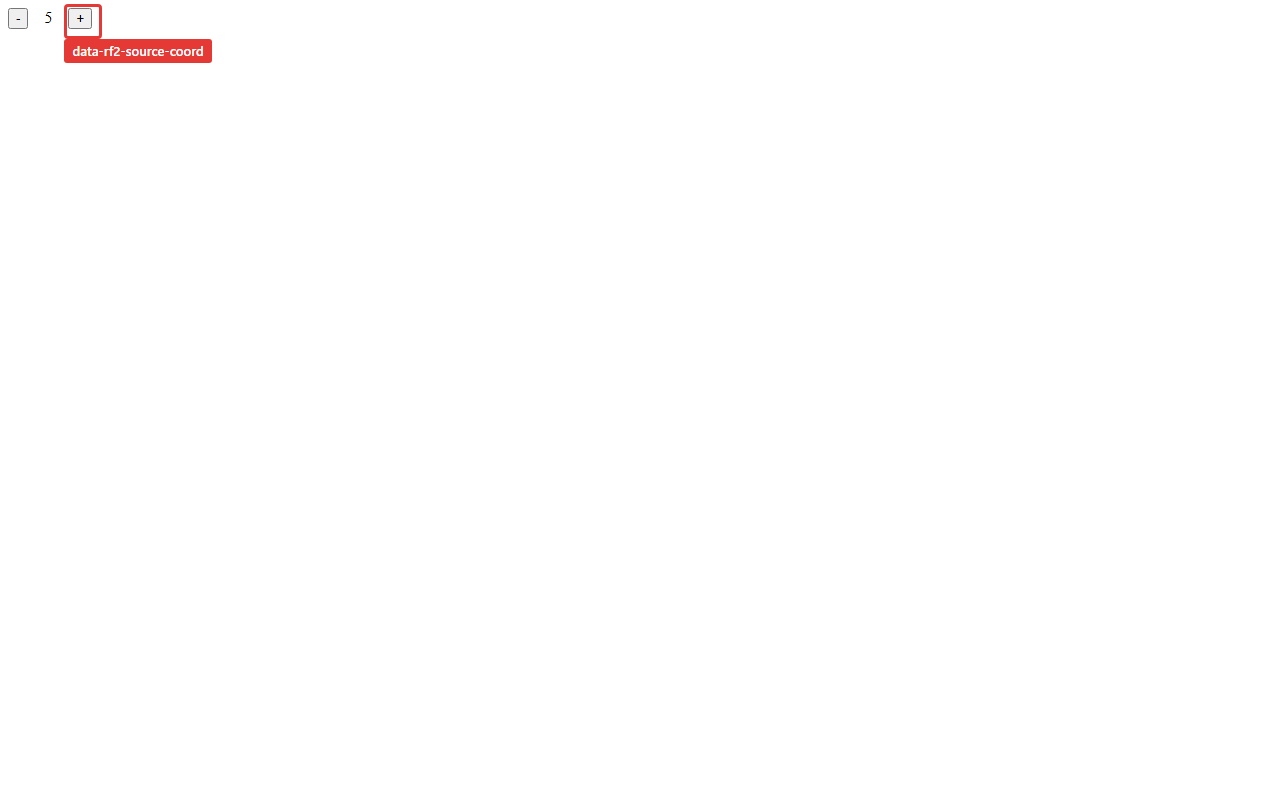
Four colon-separated segments: <ns>:<sym>:<line>:<col>. Public, parseable, forward-compatible. Tools split on the colon and recover the four pieces directly. Every reg-view-rendered DOM element has one. Click any pixel in your app, walk back to the line of code that put it there.
This isn't a Causa feature. It's a framework feature. Causa is just one of several tools that consume the attribute — re-frame2-pair reads it through nREPL to scope a dom/source-at query; Playwright specs in test runs use it to assert "this rendered element came from view :cart/total"; future tools nobody's built yet can do the same.
The Causa gesture
Inside Causa, the gesture is one click. Three places it shows up:
- In the Event-detail panel's Renders list — every view that re-rendered in the cascade has a click-target.
- In any panel that names a registered id — Subscriptions, Effects, Machines, Flows, Routes. Click the id, jump to its registration.
- From the host page directly — switch Causa into pick mode (
Ctrl+Shift+S), hover any DOM element, and the panel highlights the coord. Click to commit the gesture.
The jump uses your editor's URL handler — VS Code (vscode://), IntelliJ (idea://), Emacs (emacs://), or a generic file:// fallback. Configure the handler in Causa's settings panel; the default tries VS Code first.
The contract — data-rf2-source-coord
The four colon-separated segments are <ns>:<sym>:<line>:<col>:
<ns>— the registration's namespace (counter.core)<sym>— the registered handler-id (the symbol passed toreg-view, herecounter). Not a file path.<line>— source line atreg-viewmacro-expansion time<col>— source column
The format is a public, parseable contract. Tools split on the colon and recover the four pieces directly.
To recover the file path too, follow the parsed handler-id back to the registration metadata via :rf/source-coord-meta:
(:rf/source-coord-meta (rf/handler-meta :view :counter.core/counter))
;; → {:ns "counter.core", :file "counter/core.cljs", :line 48, :column 5}
The DOM attribute is the cheap-on-the-wire form; the registration metadata is the rich form.
The annotation is dev-only — gated on the universal re-frame.interop/debug-enabled?. Production builds elide via DCE; the rendered HTML in production carries no data-rf2-source-coord bytes.
Documented exemption: components whose outermost return is a React Fragment, a :> host-component head, or another non-DOM root are exempt. Pair tools fall back to (rf/handler-meta :view id) for those nodes.
Beyond views: state machines
The same idea generalises to state machines. reg-machine is a macro that walks its literal spec form at expansion time and attaches a flat coord index under :rf.machine/source-coords, keyed by spec-path tuples:
(:rf.machine/source-coords (rf/machine-meta :auth/login))
;; {[:guards :form-valid?]                {:ns ... :line ... :column ... :file ...}
;;  [:actions :commit]                    {...}
;;  [:states :form :on :submit]           {...}}
A pair-tool or a state-diagram visualiser reads this index for two distinct gestures: jump to definition (a click on :form-valid? in the diagram reads [:guards :form-valid?]) and jump to call site (a click on a transition arrow reads [:states :form :on :submit]).
The framework commits to the index shape and the keyword-reference rule:
- Definition-site stamping for keyword references. A keyword reference (
{:guard :form-valid?}) is stamped at its definition site ([:guards :form-valid?]), not at the call site — the call site is the keyword itself, which is identity-free. - Reference-site stamping for inline-fn literals. An inline
(fn [...] ...)is stamped where it appears.
The keyword-reference rule means call-site clicks on a keyword-named slot ({:guard :form-valid?}) fall back to the enclosing transition's coord, which IS stamped.
Like data-rf2-source-coord, the stamping is gated on debug-enabled and elides under production build flags.
What re-frame2 does not ship
The framework commits to the attribute format and the index shape — both are parseable public contracts. The framework does not ship dom-source-at / find-by-src / fire-click-at-src helpers; those depend on host-specific DOM access that re-frame2 the framework doesn't assume.
Causa ships its own pick-mode helper, its own coord-to-editor handler, its own batch "highlight every node from this view" toggle. re-frame2-pair ships its own helpers over the same attribute. They could diverge in implementation; they can't diverge in contract — the attribute is the wire.
Two recent landmarks
Click-to-source has been on the spec roadmap since before re-frame2 was named. Two recent shipments matter:
- PR #1106 (rf2-g5q8d) — open-in-editor wired through the panel's allowlist. The shipped tool opens a file in your editor when you click without prompting you for confirmation on every click. The allowlist is a security gate, not a UX gate; once configured, the gesture is friction-free.
- The
data-rf2-source-coordcontract was rolled into the spec proper —<ns>:<sym>:<line>:<col>is locked. Future tools that grew up after Causa can rely on it.
Causa's click-to-source is what closed the loop between "the framework knows where every line came from" and "the developer's first gesture in a debugging session is a click, not a grep."
Walking click-to-source on the parallel-frames testbed
The tutorial's index page opened with a five-step Causa loop on the parallel-frames testbed. The runnable version lives at tools/causa/testbeds/parallel_frames/ — one app, two frames (:above and :below), each a fully isolated reactive context.
Click-to-source is the gesture that gets you from a rendered pixel to its source line; on a multi-frame page that surface is doubly useful, because the same view source produces two live elements, one per frame, and the coord identifies both unambiguously.
The five clicks:
-
Open the testbed. Run
npm run test:examplesfromimplementation/, then visithttp://127.0.0.1:8030/parallel-frames/. Two stacked panels appear —:aboveand:below— each carrying its own counter, clock and title. -
The coord on the wire. Right-click the title text inside
:above, Copy element. The HTML carriesdata-rf2-source-coord="parallel-frames.core:title-view:198:4". The coord routes you to thetitle-viewreg-view intools/causa/testbeds/parallel_frames/core.cljs. Now right-click the same title text in:below— same coord. One source, two live mounts; the coord is the source identity. -
Views panel, scoped by frame.
Ctrl+Shift+C, switch the L1 frame picker to:above, click Views, typetitle. Causa shows::title-statusand::title-textas nodes scoped to:above's sub-cache. Flip the picker to:below. The same node ids, the same dependency edges — but the cache rows are independent. Sub recomputes in:abovedon't show in:below's panel. -
Click-to-source from a panel row. Click the registration coord chip next to
::title-status. Your editor opens at thereg-subform incore.cljs. Same gesture works on machines (:title/flow) and effect ids — every registered id carries its source coord through to the panel chrome. -
Pick mode across frames. Switch Causa into pick mode (
Ctrl+Shift+S), hover the Refresh button in:below. The panel highlightsparallel-frames.core:title-controls:<line>:<col>. Hover the same button in:above— same coord. The coord identifies the view's source; the frame identifies the live mount.
The point: click-to-source is frame-agnostic on the wire. Two mounted instances of one view share one coord. The framework's frame plumbing handles isolation downstream; the source-coord contract stays clean.