Read the exact runtime records
Open Trace when Epoch leaves an ordering, payload or failure question unanswered. Trace lists the selected epoch's records in emission order.
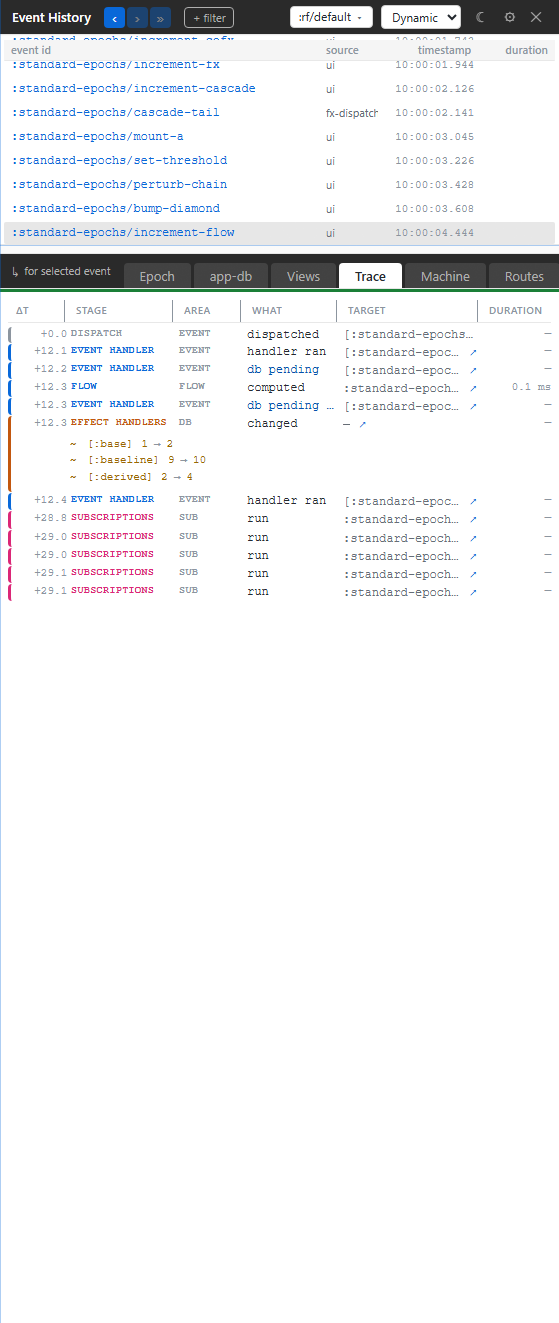
In the standard-epochs example, run step 3, select
:standard-epochs/increment-fx, and open Trace. The handler returns a
:standard-epochs/ping effect; the trace lets you check which effect actually
ran after the handler.
Read a row
| Column | Meaning |
|---|---|
| Δt | Milliseconds since the epoch's first record |
| Stage (1) | Where the operation belongs: dispatch, coeffects, interceptors, handler, flows, effects, subscriptions or views |
| Area (2) | The runtime area: EVENT, COEFFECT, DB, FX, FLOW, SUB, VIEW, MACHINE, ROUTING, RESOURCE, EPOCH, ERROR or WARNING |
| What | The exact operation keyword |
| Target | The relevant event, sub, view, path, effect, machine or route |
| Duration | Recorded elapsed time, when available |
Click a row to expand its raw record; click again to collapse it. A state-write row includes changed paths. The ↗ source link (3) opens the corresponding code when its registration has a coordinate.
Read the operation and tags together. An effect's configured reply target does not prove that the reply arrived. Its later reply event and trace do. Managed effects shows how to follow that exchange.
Cancellation cascades
Destroying a child actor can also abort its requests and timers. The destroy row's ⟲ control, or its context menu, groups those records into a cancellation cascade: the decision, teardown and aborted work, in order. Click an entry to jump to its trace row; Esc closes the cascade view.
If a request vanished, check this evidence before adding a retry. Cancelling work owned by a destroyed actor can be the expected outcome.
Troubleshooting
| Symptom | Meaning | Action |
|---|---|---|
| No records for an old row | Its epoch evidence was evicted or never settled | Select a retained completed event and reproduce if needed |
| An error happened outside an event | It belongs to the ungrouped bundle | Enable Show :ungrouped pseudo-event-bundle events in L2 in General settings, then select <no event> |
| A payload has a redaction or size marker | Display classification withheld the value | Inspect its surrounding tags; see local visibility |
| A row has no duration | That operation has no timing evidence | Do not treat the blank as zero |
Your own tests or tools can read the same runtime stream. The observability guide shows how to register and remove a trace listener.