Find what feeds a value
Use Graph when you need to trace a derived value's dependencies without reproducing a particular event. The panel lists subscription, flow, resource, route and machine nodes and the edges between them.
Inspect the example's flow
Run step 5 in standard-epochs, then open Graph. The default static
mode lists registered definitions. The header counts the represented nodes
and edges (2).
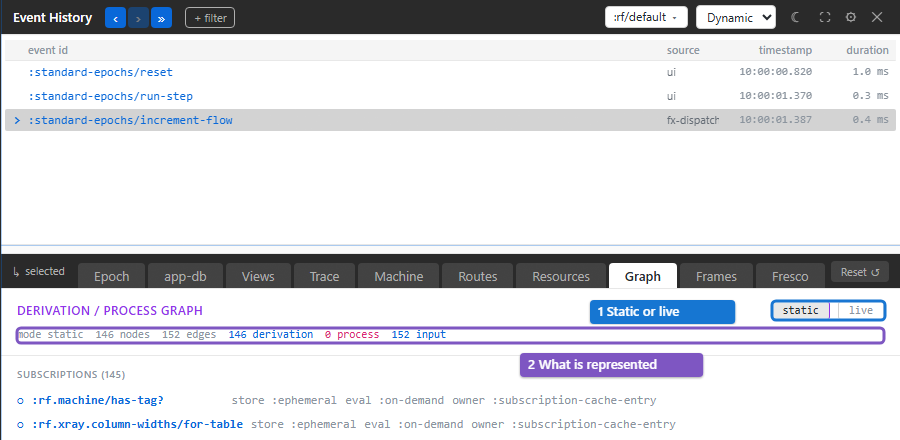
Scroll past Subscriptions to Flows and find
:standard-epochs/derived (3). Its row says that it stores its result in
:app-db, evaluates :after-event and lives as long as its frame.
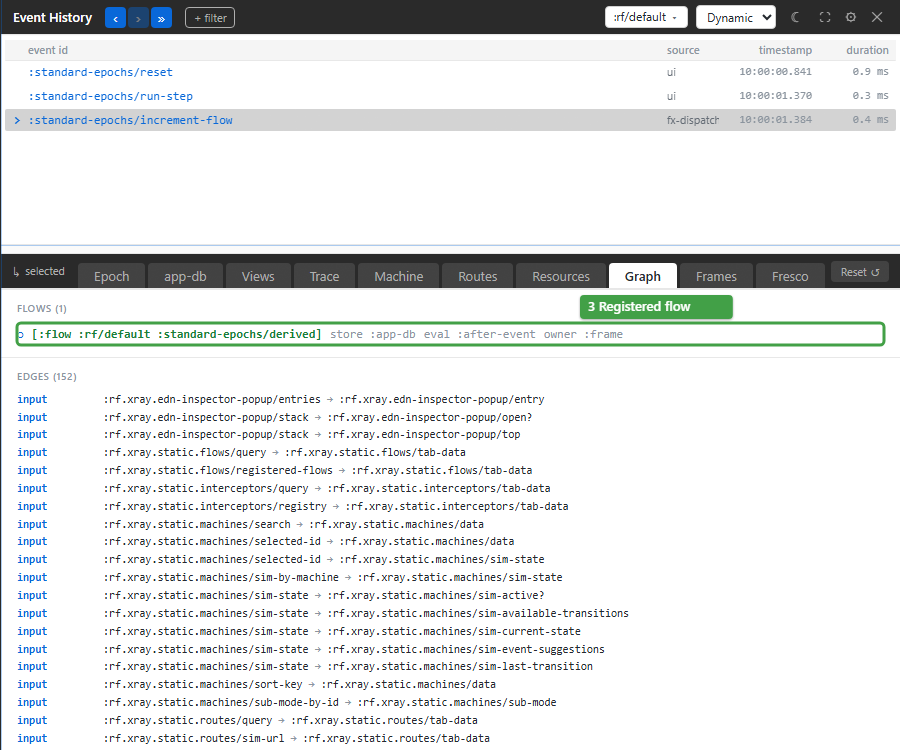
This flow calculates from [:base] and writes to [:derived]. Read its
calculation and declared paths in Static → Flows; Graph describes its
classification and relationships.
Switch to live (1) to inspect the concrete queries, machine instances, route slice and cache entries in the observed frame. Mount Child A with step 6, then compare the live subscriptions with the registered ones. A parametric subscription contributes concrete input edges only when its query has been realized.
Use Static → Flows when you want a flow's registration details alone. Use Epoch → FLOW when you want the value it wrote during one event.
Read a node
A derivation (○) computes from inputs. A process (◆) retains state, such as a resource cache entry or machine snapshot. The row's labels help you decide where to investigate:
| Label | Question answered | Example |
|---|---|---|
store |
Where is the value stored locally? | A flow writes :app-db; a resource uses :runtime-db |
eval |
What triggers evaluation? | A subscription is :on-demand; a flow is :after-event |
owner |
Which lifetime keeps it alive? | A frame, subscription-cache entry, route or machine instance |
authority |
Does its source of truth live elsewhere? | A resource can be :remote while cached locally |
parametric |
Does its dependency set need a concrete query? | A subscription with an argument |
Edges identify input, parameter and selector relationships. A missing family section means the current graph has no nodes in that family. The derivations guide explains the full classification vocabulary.
Troubleshooting
| Symptom | Meaning | Action |
|---|---|---|
| A parametric sub has no static edges | Its inputs depend on a realized query | Read it in the app and inspect live mode |
| A live graph is empty | The selected frame is missing, destroyed or has no realized nodes | Choose the live app frame and reproduce its reads |
| Registered nodes exist but no edges connect them | No relationship is known in this mode | Check the definitions and compare live mode; a node's presence does not imply an edge |
| Selecting an older event does not change the graph | Graph is a structural/current-state view | Use Epoch, Views or Trace for that event |
Opening Graph dispatches no application event and keeps no application resource alive. Exporting graph evidence through another tool applies that tool's egress profile; classified value fields can be redacted even when the node ids and relationships remain visible.