Turn a diagnosis into a regression test
Use Story to reproduce a state or interaction with controlled inputs, tests to decide whether its assertions pass, and Xray to explain the events behind the result. Keep the reproduction and assertions together so fixing a bug leaves a scenario you can run again.
Append this regression to the login testbed's
tools/story/testbeds/login_form/stories.cljc, outside register-all!:
;; The testbed namespace already requires [re-frame.story :as rf.story].
(rf.story/reg-variant :story.login-form/error-regression
  {:extends :story.login-form/error
   :script [[:assert [:rf.assert/state-is :login/flow :error]]
            [:assert [:rf.assert/sub-equals
                      [:login/error] "Invalid credentials."]]]
   :tags #{:dev :test}})
The parent testbed variant supplies the login setup and stubbed failure. This variant checks the machine state and the message derived from it. In your app, extend the corresponding registered scenario and assert the behaviour the fix must preserve.
Follow a failing assertion into Xray
In Story's Tests tab:
- Open show detail on the failed assertion. Compare expected and actual.
- Choose open in Evidence →. Story selects the script step that failed in its Evidence panel.
- Follow Xray: Epoch, Xray: App-db or Xray: Trace on the event belonging to that step.
- Read the responsible handler, state write or machine transition and follow its source link. Fix the cause, then rerun the same variant.
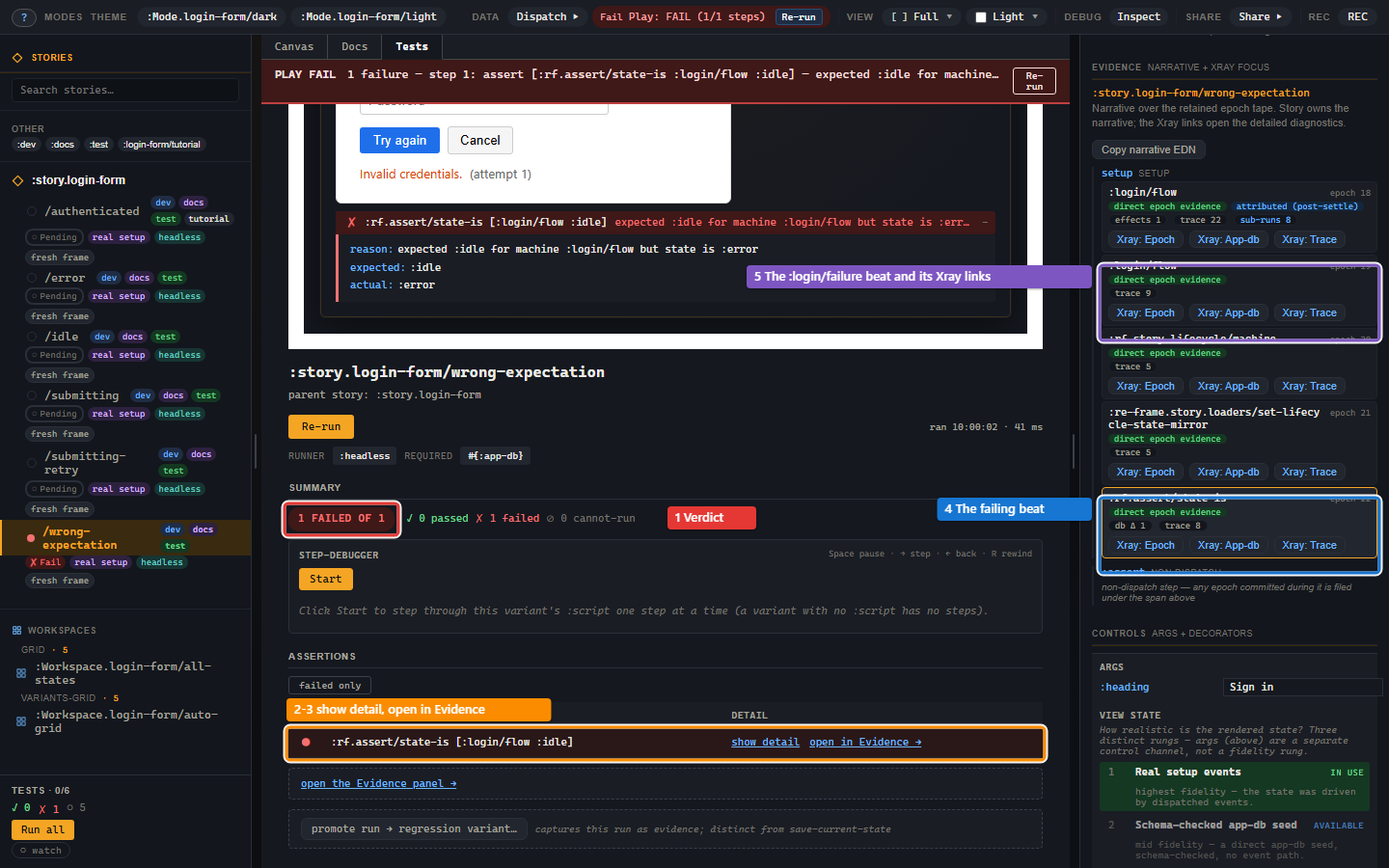
The Story failure walkthrough follows an intentionally wrong expectation through these controls. That example is a diagnostic exercise; the regression assertion above states the correct result.
Xray in Story's right rail
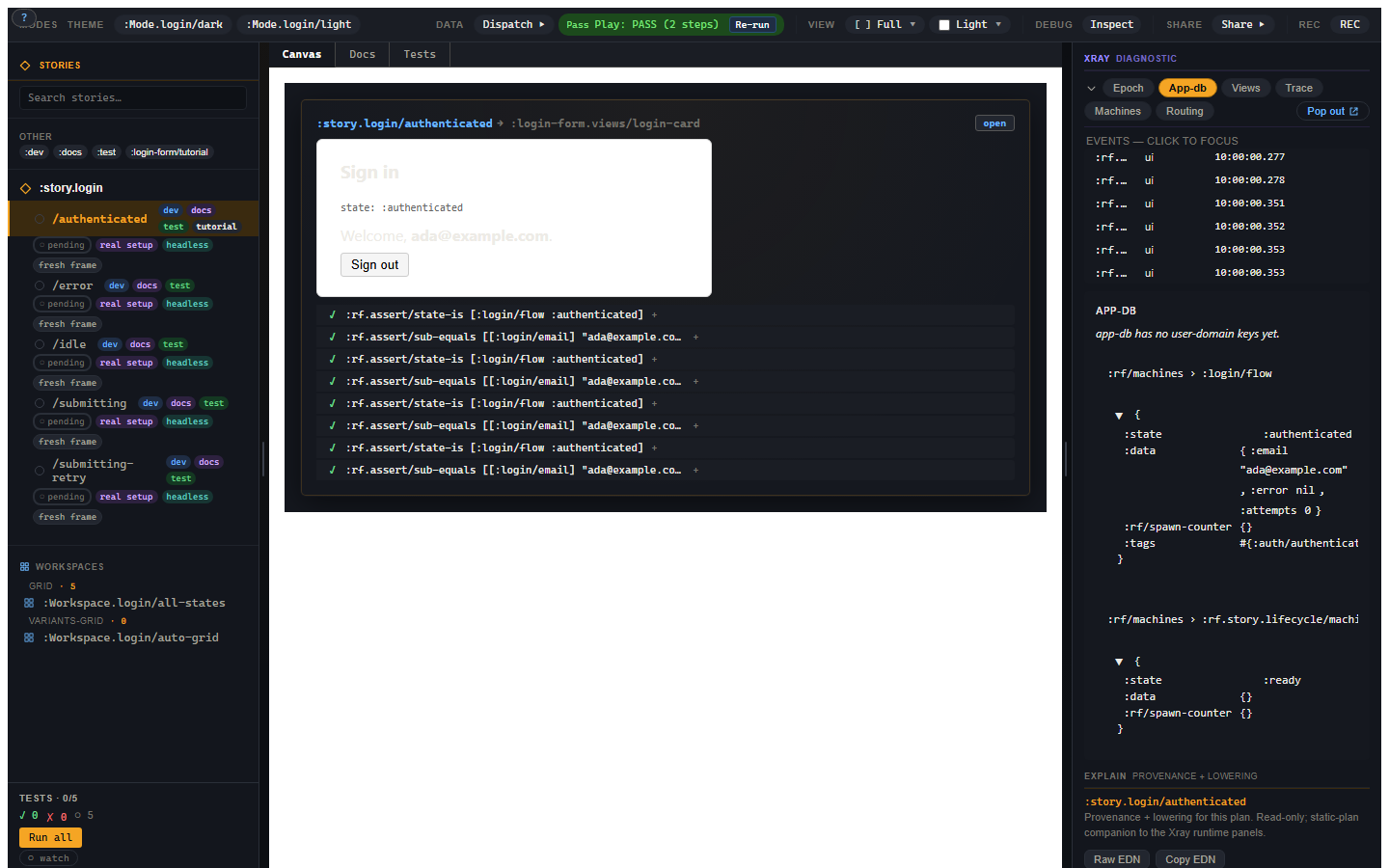
Story gives each variant its own frame. The rail observes the selected variant's frame and offers Epoch, App-db, Views, Trace, Machines and Routing. Selecting a different variant changes the observed frame; selecting an event pins that epoch. Pop out opens the full Xray shell with its other panels.
Story disables Xray's global keyboard shortcuts to keep its own keys
available. Use the mouse inside this embedded inspector and its pop-out.
A custom host can make the same frame/epoch/panel handoff with
focus!.
Run the same assertion in CI
The shell makes a scenario visible; story/is reports the same scenario's
assertions through your test runner. Here is a JVM test using the shipped
portable login-form registrations:
(ns my-app.login-regression-test
  (:require [clojure.test :refer [deftest use-fixtures]]
            [re-frame.epoch]
            [re-frame.story :as story]
            [re-frame.substrate.plain-atom :as plain]
            [re-frame.test-support :as ts]
            [login-form.stories]))

(use-fixtures :each
  (ts/make-reset-runtime-fixture {:adapter plain/adapter}))

(deftest invalid-credentials-remain-visible
  (story/is :story.login-form/error-regression))
The test classpath needs the Story and epoch artefacts and the testbed's source
path. In your app, require your own .cljc stories namespace instead of
login-form.stories. A headless runner checks events and state; a scenario
with DOM steps needs a runner with the required DOM capabilities. The
Story test guide
includes ClojureScript's asynchronous test form and runner choices.
When the bug came from a live app
From Xray, collect the initial state, the ordered event vectors and each event's recordable coeffects. Preserve external replies as stubs. Replaying the event vectors without their clock, generated ids or reply inputs may produce a different run.
For a state-only regression, dispatch those events in an isolated test frame. For a state worth inspecting visually, make a Story variant and keep the assertions in it. The pipeline testing guide shows the isolated-frame replay.
Troubleshooting
| Symptom | Meaning | Action |
|---|---|---|
:fail despite correct final state |
A check failed or unconsumed failure evidence remains | Read the failed assertion and schema/error evidence |
:cannot-run |
The runner lacks required capabilities | Choose a capable runner or keep this regression at a state-only level |
:error |
Running the scenario itself failed | Read the exception and execution details; this is not an assertion pass |
| No epochs in a headless run | The epoch artefact was not loaded or evidence was not retained | Require re-frame.epoch and rerun with enough retention |
| A variant created in the shell disappears on reload | Its registration was only in memory | Copy the generated form into the stories namespace |
Xray never changes these verdicts. It supplies evidence to help you fix the behaviour that the assertion checks.