Follow an event from input to state
An interaction changed more state than you expected. Follow one event through
its handler and a derived value, then check the state it actually installed.
The standard-epochs example supplies the registrations and Xray setup for
this exercise.
Open http://localhost:8031. Click Run beside step 5, which runs
:standard-epochs/increment-flow. If you have already used the example,
reload first so the starting values are the same.
The handler being exercised is small:
;; cf. tools/xray/testbeds/standard_epochs/core.cljs
(require '[re-frame.core :as rf])

(rf/reg-event :standard-epochs/increment-flow
  (fn [{:keys [db]} _event]
    {:db (update db :base inc)}))
The example starts with :base equal to 1. A registered flow calculates
(* 2 base) and writes it to :derived. You should finish with :base 2
and :derived 4.
Read the event that did the work
Choose the app's frame in the ribbon if none is selected. The runner produces
both a :standard-epochs/run-step event, which updates its step cursor, and
the child event :standard-epochs/increment-flow. Select the child event,
then open Epoch.
Read the numbered steps in order:
- DISPATCH identifies the event vector and where the dispatch came from.
- EVENT HANDLER shows the handler's source and its returned
:dband:fx. Here,:basechanged from1to2. - FLOW shows the derived write. The handler did not write
:derived; the flow did. - SUBSCRIPTIONS and VIEWS, when present, show the work that reacted to these changes. Steps with no evidence are omitted.
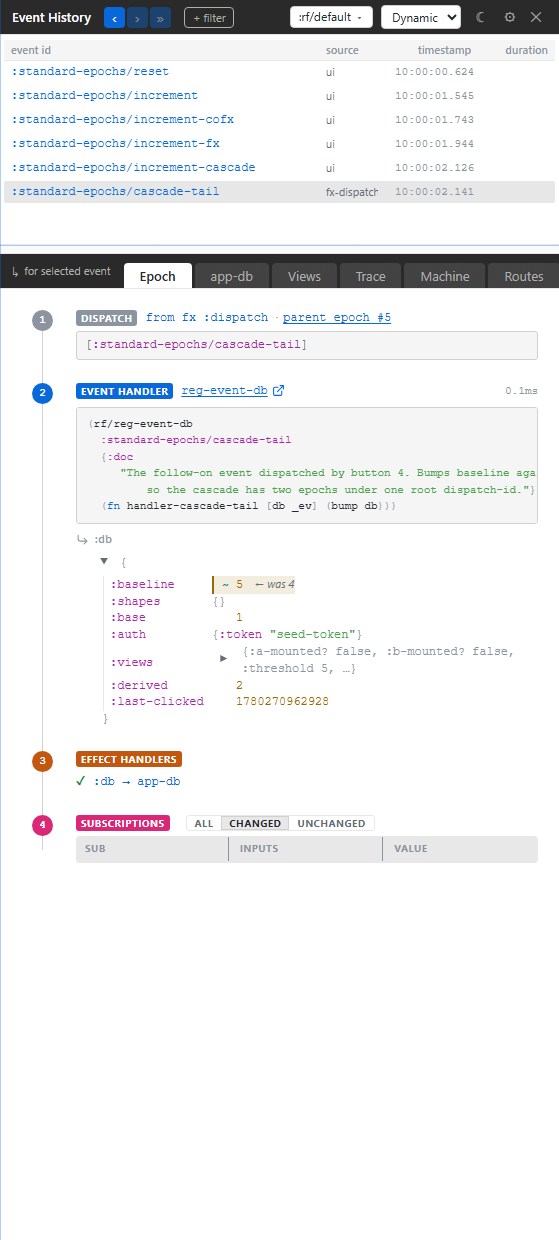
The screenshot selects the first flow event after running step 5 twice. Newer events remain in the list while the detail panel shows the selected snapshot. A child dispatch has its own event row and epoch.
Confirm the result
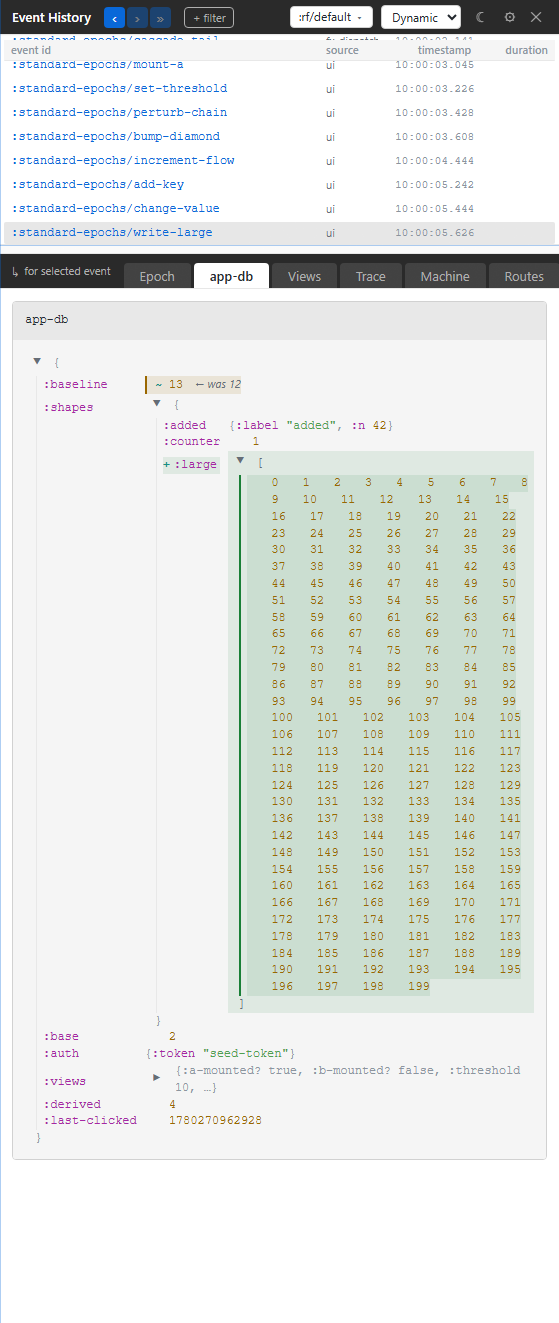
Open app-db and find :base and :derived. The tree shows the state
after your selected event. ← was marks the old value beside each changed
value. The screenshot below shows this same flow after the example's first
five steps.
Run step 5 again and select its newest child event. Now the values should be
:base 3 and :derived 6. Select the older row again: Xray still shows
2 and 4, while the live example remains at 3 and 6.
This separates two common bugs: the handler wrote the wrong input, or a downstream computation produced the wrong output. Follow the source link on the step responsible for the unexpected value.
Troubleshooting
| Symptom | Check | Action |
|---|---|---|
Only :step changed |
You selected the runner's run-step event |
Select :standard-epochs/increment-flow |
| The expected values are higher | The example has already run | Reload and run step 5 once |
| The detail panel stays on the old event | An older row is selected or following is paused | Select the new row, or press » to follow |
| No event appears | Frame selection, filters and mutes | Choose the app frame and remove the filters hiding it |
| A row has no epoch | It was rejected before settling, is still running, or its evidence is no longer retained | Reproduce the action and inspect its newest completed row |